Ear Piercing Chart: Types, Pain Levels, Healing Time & Placement Guide
Choosing your next ear piercing should feel exciting not confusing. Yet many people spend hours scrolling through Pinterest, Instagram, and TikTok trying to figure out the difference between a helix, conch, rook, or daith piercing. Questions like How much will it hurt?, How long will it take to heal?, and Will this piercing actually suit my ear? are completely normal.
One of the biggest mistakes people make is choosing a piercing based only on how it looks. In reality, your ear anatomy, pain tolerance, lifestyle, and commitment to aftercare all play a role in whether you’ll enjoy the result. A piercing that looks amazing on someone else may not be the right choice for your ear.
We’ve researched professional piercing guidance, compared leading industry resources, and analyzed the most common questions people ask before getting their ears pierced. This guide brings that information together in one easy-to-follow ear piercing chart so you can compare every popular piercing by placement, pain level, healing time, jewelry options, and aftercare requirements.
Whether you’re getting your first lobe piercing or planning a fully curated ear stack, this guide will help you make a more informed decision before you book your appointment.
By the end of this guide, you’ll know:
- Every type of ear piercing and its location
- Which piercings usually hurt the most and the least
- Average healing times for each placement
- The best jewelry for new piercings
- How to care for a healing piercing
- Which piercings work well together for a balanced ear stack
What Is an Ear Piercing Chart?
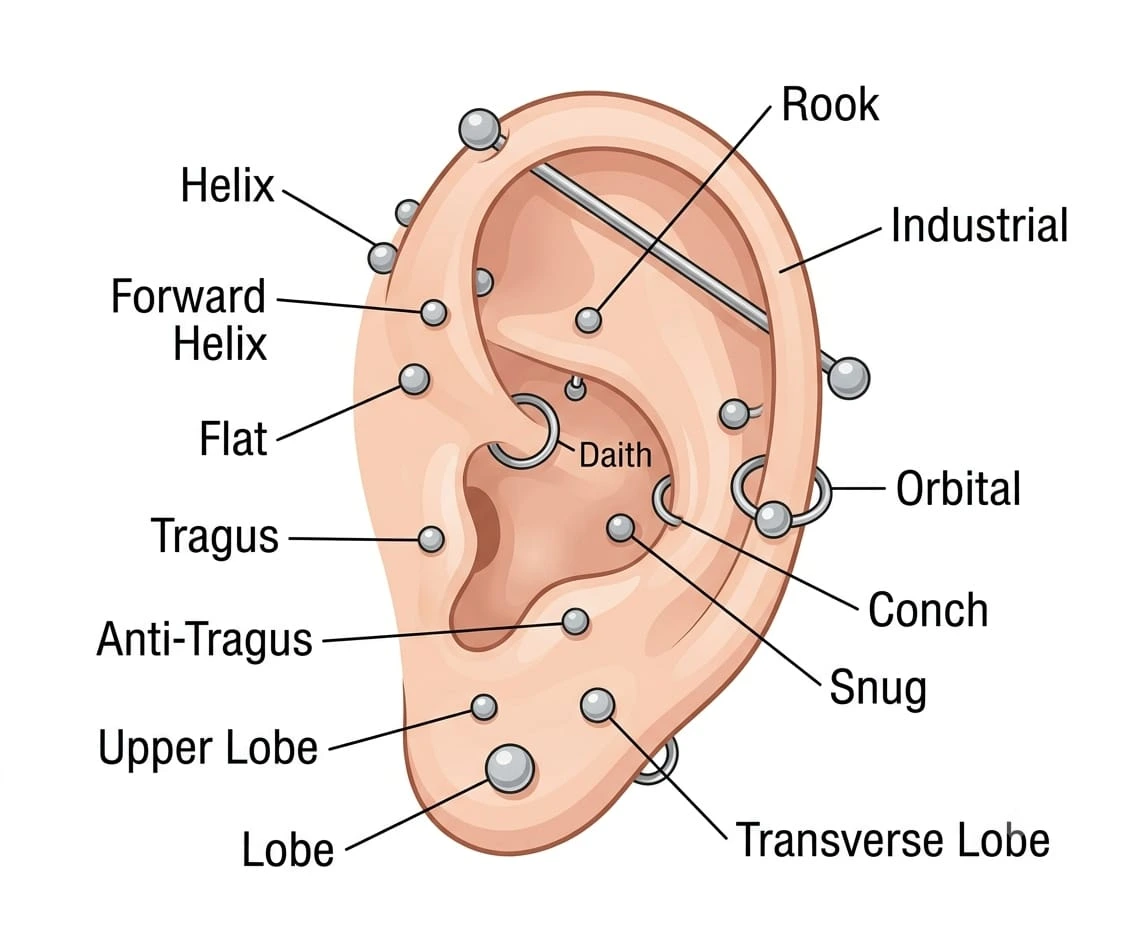
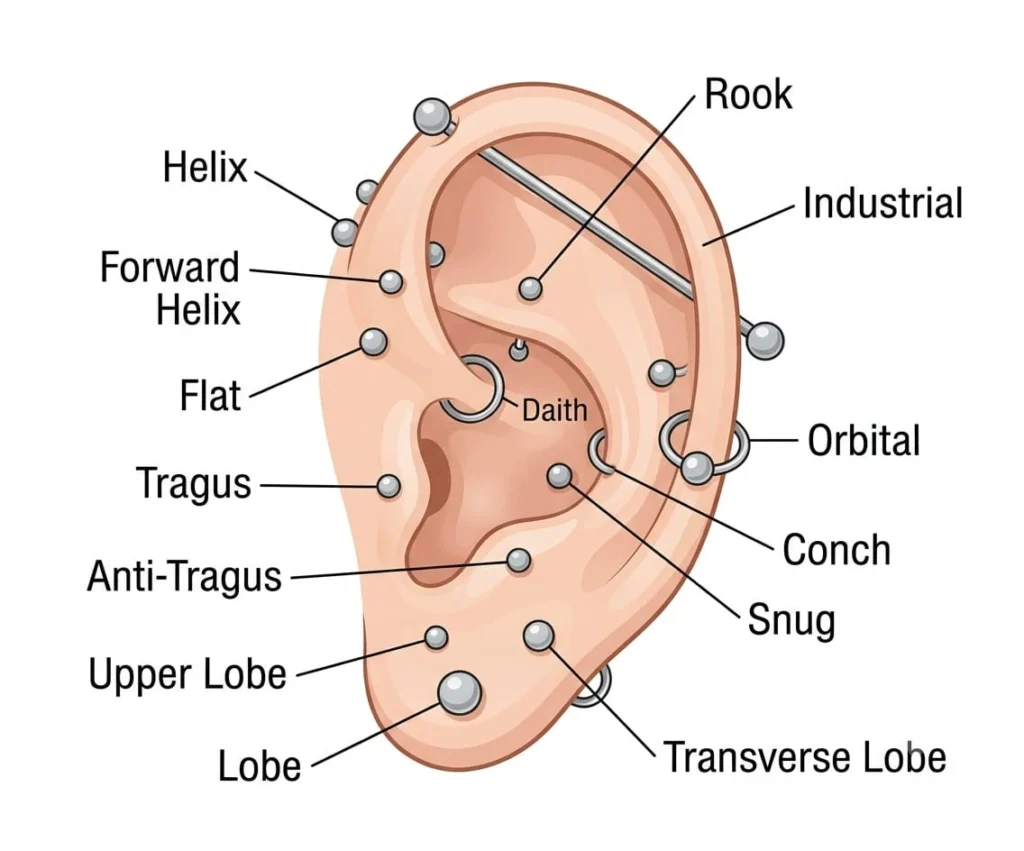
An ear piercing chart is a visual guide that shows the names and locations of different ear piercings. Instead of guessing where a helix, conch, or rook piercing sits, you can quickly identify each placement just by looking at the diagram.
Most ear piercing charts go beyond simple location markers. They typically compare several factors side by side, including:
- Pain levels
- Healing times
- Recommended jewelry
- Cartilage or soft tissue placement
- Difficulty level
- Suitable anatomy
Using an ear piercing chart makes it much easier to compare different styles before booking your appointment. It also helps you plan a balanced ear stack by showing how multiple piercings look together once healed.
Complete Ear Piercing Chart
| Piercing | Location | Tissue | Pain Level | Average Healing |
|---|---|---|---|---|
| Lobe | Bottom of the ear | Soft tissue | Low | 6–8 weeks |
| Upper Lobe | Above the lobe | Soft tissue | Low | 6–8 weeks |
| Helix | Outer upper rim | Cartilage | Mild | 6–12 months |
| Forward Helix | Front of the helix | Cartilage | Moderate | 6–12 months |
| Flat | Flat upper cartilage | Cartilage | Moderate | 6–12 months |
| Conch | Center bowl of the ear | Cartilage | Moderate to High | 6–12 months |
| Tragus | Small flap over ear canal | Cartilage | Moderate | 6–12 months |
| Daith | Inner cartilage fold | Cartilage | Moderate | 9–12 months |
| Rook | Upper inner ridge | Cartilage | High | 6–12 months |
| Snug | Inner antihelix ridge | Cartilage | High | 9–12 months |
| Industrial | Two connected helix piercings | Cartilage | High | 9–12 months |
| Anti-Tragus | Opposite the tragus | Cartilage | Moderate to High | 9–12 months |
| Orbital | Two piercings joined by one ring | Soft tissue or cartilage | Moderate | 6–12 months |
| Transverse Lobe | Horizontal through the lobe | Soft tissue | Moderate | 2–6 months |
Tip: Pain levels vary from person to person. Your anatomy, pain tolerance, and your piercer’s technique all play a role in how much a piercing actually hurts.
Understanding Ear Anatomy Before Choosing a Piercing
Knowing the basic anatomy of your ear can make it much easier to choose a piercing that suits both your personal style and your natural ear shape. The ear is generally divided into two main areas: the earlobe and the cartilage.
Earlobe
The earlobe is the soft, fleshy part located at the bottom of the ear. Because it’s made up of fatty tissue rather than cartilage, it tends to heal faster and cause noticeably less discomfort during the piercing process.
For this reason, lobe piercings are often recommended for beginners. They’re easy to heal, forgiving of minor aftercare slip-ups, and open the door to a wide range of jewelry options right from the start.
Ear Cartilage
Everything above the earlobe is supported by cartilage. This tissue is firmer than the lobe and has a much lower blood supply, which is exactly why cartilage piercings generally take far longer to heal.
Popular cartilage piercings include:
- Helix
- Forward helix
- Flat
- Tragus
- Conch
- Daith
- Rook
- Snug
- Industrial
Although cartilage piercings usually demand more patience during healing, they also unlock some of the most eye-catching and creative ear styling combinations available.
What Is Ear Mapping?
Ear mapping is the process of evaluating your ear’s unique anatomy to determine which piercings will look balanced and heal successfully on your specific ear. During this assessment, professional piercers examine the shape of your cartilage, the size of your earlobe, and the natural curves of your ear before recommending suitable placements.
Not every ear can support every piercing. For example, some people simply don’t have enough cartilage to safely support an industrial, rook, or anti-tragus piercing. A proper anatomy assessment helps reduce the risk of complications while creating a curated look that genuinely complements your features.
Ear mapping becomes especially valuable if you’re planning to build out multiple piercings over time, since it allows your piercer to design a cohesive ear stack rather than placing each new piercing in isolation.
Types of Ear Piercings
Ear piercings generally fall into two broad categories: lobe piercings and cartilage piercings. Understanding the difference between them is the first step toward choosing the right style for you.
Lobe Piercings
Lobe piercings pass through the soft tissue at the bottom of the ear. They heal relatively quickly, are considered beginner-friendly, and pair well with studs, hoops, huggies, and dangling earrings alike.
Common lobe styles include:
- First lobe
- Second lobe
- Third lobe
- Stacked lobe
- Transverse lobe
Cartilage Piercings
Cartilage piercings go through the firmer, upper part of the ear. While they typically take longer to heal than lobe piercings, they also allow for far more creative jewelry combinations and fully curated ear designs.
Popular cartilage piercings include:
- Helix
- Forward Helix
- Flat
- Tragus
- Anti-Tragus
- Conch
- Daith
- Rook
- Snug
- Industrial
- Orbital
Lobe Piercing
The lobe piercing is the most popular ear piercing in the world, and it’s usually the very first piercing people choose. Because it sits in the soft tissue at the bottom of the ear, it’s also one of the easiest and fastest piercings to heal.
Thanks to the lobe’s excellent blood circulation, healing tends to move along much faster than any cartilage piercing. Most people describe the procedure itself as a brief pinch, followed by mild soreness that fades within a few days.
Lobe piercings are also incredibly versatile once healed. You can style them with classic studs, small hoops, huggie earrings, or statement designs, and swap between looks whenever the mood strikes. For another style-focused look, check out our guide to Blowout Taper Fade.
Quick Facts
- Location: Bottom of the earlobe
- Pain Level: Low (about 2/10)
- Healing Time: 6–8 weeks
- Jewelry: Studs, hoops, huggies, threaders
- Best For: Beginners
Upper Lobe Piercing
An upper lobe piercing sits slightly above the traditional lobe piercing but still passes through soft tissue rather than cartilage, keeping healing straightforward.
It’s a popular choice for anyone who wants a layered ear stack without stepping into cartilage territory. Many people pair an upper lobe piercing with a first or second lobe piercing to build a balanced, elegant look.
Healing follows a similar timeline to a standard lobe piercing, although the tissue in this area may feel slightly firmer during the first few days.
Quick Facts
- Location: Upper section of the earlobe
- Pain Level: Low
- Healing Time: 6–8 weeks
- Jewelry: Flat-back studs, hoops, huggies
- Best For: Ear stacking
Helix Piercing
A helix piercing sits along the outer rim of the upper ear and is one of the most requested cartilage piercings, largely because it suits almost every ear shape and offers endless styling flexibility.
A single helix creates a clean, minimalist look, while double and triple helix piercings can be combined to build a bolder, statement-making ear stack over time.
Since the helix passes through cartilage, healing takes considerably longer than a lobe piercing. During this period, it’s important to avoid sleeping directly on the pierced ear and to protect it from bumps or accidental snags.
Quick Facts
- Location: Outer upper cartilage
- Pain Level: Mild to Moderate (4–5/10)
- Healing Time: 6–12 months
- Jewelry: Flat-back studs, hoops after healing
- Best For: Minimalist and modern ear stacks
Forward Helix Piercing
A forward helix piercing sits at the front of the ear, right where the outer rim meets the face. It creates a delicate, elegant appearance and is commonly worn as a single, double, or even triple piercing.
Because the available space is smaller than a standard helix, jewelry choices are a bit more limited here. Small gemstone studs and flat-back earrings tend to be the most popular options for this placement.
The forward helix also pairs beautifully alongside a standard helix, conch, or tragus piercing, helping create a balanced, fully curated ear.
Quick Facts
- Location: Front upper cartilage
- Pain Level: Moderate (5/10)
- Healing Time: 6–12 months
- Jewelry: Flat-back studs
- Best For: Curated ear styling
Tragus Piercing
A tragus piercing passes through the small flap of cartilage sitting just in front of your ear canal. Despite its small size, it creates a bold, modern look and pairs well with lobe, helix, and conch piercings for a well-rounded curated ear.
Because the tragus has thicker cartilage than the earlobe, you may feel more pressure during the actual piercing. Many people also hear a slight popping sound as the needle passes through — this is completely normal and nothing to worry about.
During healing, it’s best to avoid earbuds or in-ear headphones, since they can irritate the fresh piercing and slow down recovery.
Quick Facts
- Location: Small cartilage flap covering the ear canal
- Pain Level: Moderate (4–5/10)
- Healing Time: 6–12 months
- Jewelry: Flat-back studs, small hoops after healing
- Best For: Minimalist and balanced ear stacks
Anti-Tragus Piercing
The anti-tragus piercing sits on the small piece of cartilage directly above the earlobe, opposite the tragus. It’s less common than most other ear piercings simply because not everyone has enough cartilage in this area to support it safely.
Before performing this piercing, a professional piercer will first examine your ear anatomy to confirm whether it’s a suitable placement. If there isn’t enough tissue available, they may recommend an alternative spot instead.
When it does work for your anatomy, the anti-tragus creates a genuinely unique look and pairs beautifully with a tragus, conch, or double lobe piercing.
Quick Facts
- Location: Cartilage above the earlobe opposite the tragus
- Pain Level: Moderate to High (6/10)
- Healing Time: 9–12 months
- Jewelry: Curved barbells, small studs
- Best For: Unique ear styling
Flat Piercing
A flat piercing sits on the broad, flat section of cartilage between the helix and the anti-helix. This area offers plenty of room, which makes it ideal for creative and layered jewelry arrangements.
Many people opt for a single flat piercing, while others build out a constellation design using two or three small gemstone studs. Either way, this placement works especially well within minimalist and luxury ear stacks.
Because the cartilage here is relatively thick, you should expect a longer healing period compared to a standard lobe piercing.
Quick Facts
- Location: Flat upper cartilage
- Pain Level: Moderate (5/10)
- Healing Time: 6–12 months
- Jewelry: Flat-back studs
- Best For: Constellation piercings and curated ears
Conch Piercing
The conch piercing sits in the center of your ear’s inner cartilage, an area whose curved shape resembles a seashell. It’s one of the most versatile cartilage piercings, since it can be worn with a simple stud during healing and later upgraded to a hoop that wraps around the outer ear.
Although the cartilage here is thicker than in many other placements, most people find the actual pain manageable. The piercing itself only takes a few seconds, while the real commitment lies in the patience and aftercare required during healing.
Conch piercings pair especially well with helix, tragus, and lobe piercings, making them a strong anchor point for a larger ear stack.
Quick Facts
- Location: Center bowl of the ear
- Pain Level: Moderate to High (6–7/10)
- Healing Time: 6–12 months
- Jewelry: Flat-back studs, hoops after healing
- Best For: Statement ear styling
Daith Piercing
A daith piercing passes through the thick fold of cartilage just above the ear canal, and it has become one of the most recognizable cartilage piercings thanks to its distinctive, tucked-in appearance.
Some people choose a daith piercing because they believe it may help with migraines. While plenty of personal anecdotes suggest possible benefits, there’s currently no strong scientific evidence confirming that a daith piercing can treat or prevent migraines — most people choose it purely for its style.
The daith typically heals well because it sits tucked inside the ear, making it less likely to catch on clothing or hair during the healing process.
Quick Facts
- Location: Inner cartilage fold above the ear canal
- Pain Level: Moderate (5/10)
- Healing Time: 9–12 months
- Jewelry: Clicker rings, captive bead rings, curved barbells
- Best For: Unique and elegant ear styling
Rook Piercing
A rook piercing is placed through the raised fold of cartilage located just above the daith. Its tucked, hidden position creates a subtle yet eye-catching look that fits naturally into a curated ear.
Since the cartilage in this area is thicker than at the helix, many people experience more pressure during the procedure itself. Healing also tends to take longer, largely because blood flow to this part of the ear is fairly limited.
A curved barbell is usually recommended as starter jewelry here, since it supports more comfortable movement while the piercing heals.
Quick Facts
- Location: Upper inner cartilage ridge
- Pain Level: High (6/10)
- Healing Time: 6–12 months
- Jewelry: Curved barbells
- Best For: Unique cartilage styling
Snug Piercing
The snug piercing runs horizontally through the anti-helix, the raised ridge of cartilage inside your ear. It’s one of the rarest ear piercings around, mainly because it requires specific anatomy and sufficiently thick cartilage.
Many professional piercers consider the snug one of the more demanding ear piercings to heal. Swelling can linger longer than with other cartilage piercings, and sleeping on the pierced side may feel uncomfortable for several months afterward.
If your anatomy isn’t quite suitable for a true snug, your piercer may suggest a faux snug instead — this uses two separate piercings to mimic a similar look while making the healing process considerably easier.
Quick Facts
- Location: Anti-helix cartilage
- Pain Level: High (7/10)
- Healing Time: 9–12 months
- Jewelry: Curved barbells
- Best For: Advanced piercing enthusiasts
Industrial Piercing
An industrial piercing connects two cartilage piercings with a single straight barbell. The most common version joins the upper helix and the forward helix, creating one of the boldest ear piercing styles available.
Not every ear is suitable for this placement. Your ear needs enough space and the right cartilage shape for the barbell to sit comfortably, so an experienced piercer should always assess your anatomy carefully before performing it.
Because it essentially combines two cartilage piercings into a single connected piece of jewelry, healing usually takes longer than most other ear piercings on this list.
Quick Facts
- Location: Two connected helix piercings
- Pain Level: High (7–8/10)
- Healing Time: 9–12 months
- Jewelry: Straight industrial barbell
- Best For: Bold and edgy styles
Orbital Piercing
An orbital piercing uses two separate piercings connected by a single ring. Unlike an industrial piercing, which relies on a straight barbell, an orbital forms a complete circle around the tissue between the two piercing points.
This style can be placed in different parts of the ear, including the lobe, helix, or conch. Cartilage orbitals generally take longer to heal than lobe orbitals, simply because cartilage receives less blood flow overall.
For anyone looking for something a little different from traditional studs or hoops, the orbital piercing is a striking and creative option.
Quick Facts
- Location: Two connected piercings joined by one ring
- Pain Level: Moderate to High (6/10)
- Healing Time: 6–12 months
- Jewelry: Captive bead rings, seamless rings
- Best For: Creative ear styling
Transverse Lobe Piercing
A transverse lobe piercing passes horizontally through the earlobe, rather than front to back like a standard lobe piercing. The jewelry enters one side of the lobe and exits the other, creating a distinctive, layered look.
This placement requires enough lobe tissue to sit safely, so it isn’t suitable for every ear. A professional piercer will evaluate your anatomy carefully before recommending this style.
Although it still passes through soft tissue, the longer piercing channel means healing can take a bit more time than a traditional lobe piercing.
Quick Facts
- Location: Horizontal through the earlobe
- Pain Level: Moderate (5–6/10)
- Healing Time: 2–6 months
- Jewelry: Straight barbells
- Best For: Unique lobe designs
Surface Tragus Piercing
A surface tragus piercing sits on the skin in front of the ear, rather than through the tragus cartilage itself. Because it’s technically a surface piercing, it behaves quite differently from standard ear piercings.
Surface piercings carry a higher chance of migration and rejection, since the jewelry sits just beneath a shallow layer of skin. Proper placement and high-quality jewelry play a major role in improving healing success here.
This placement offers a modern, unexpected appearance, but it does require extra care and regular monitoring throughout the healing process.
Quick Facts
- Location: Skin in front of the tragus
- Pain Level: Moderate (4–6/10)
- Healing Time: 3–6 months
- Jewelry: Surface bars
- Best For: Alternative piercing styles
Cartilage Piercings vs. Lobe Piercings
Choosing between a lobe and a cartilage piercing is usually one of the first big decisions you’ll make. While both can look equally stylish, they differ significantly in healing time, pain level, and ongoing aftercare requirements.
| Feature | Lobe Piercing | Cartilage Piercing |
| Tissue | Soft tissue | Cartilage |
| Pain | Low | Mild to High |
| Healing Time | 6–8 weeks | 6–12 months |
| Difficulty | Beginner-friendly | Moderate to Advanced |
| Jewelry | Studs, hoops, huggies | Flat-back studs, barbells, hoops |
| Best For | First piercings | Curated ear styling |
Ear Piercing Pain Chart
Understanding pain levels can help you choose a piercing that matches your personal comfort threshold. While everyone experiences pain a little differently, cartilage piercings usually hurt more than lobe piercings simply because the tissue is thicker and has less blood flow.
It’s also worth remembering that the piercing itself only lasts a few seconds — the tenderness that follows during healing tends to last far longer than the initial pinch.
| Ear Piercing | Pain Level | Healing Time | Difficulty |
| Lobe | ⭐⭐☆☆☆ (2/10) | 6–8 weeks | Easy |
| Upper Lobe | ⭐⭐☆☆☆ (2/10) | 6–8 weeks | Easy |
| Helix | ⭐⭐⭐⭐☆ (4/10) | 6–12 months | Moderate |
| Tragus | ⭐⭐⭐⭐☆ (4/10) | 6–12 months | Moderate |
| Forward Helix | ⭐⭐⭐⭐⭐ (5/10) | 6–12 months | Moderate |
| Flat | ⭐⭐⭐⭐⭐ (5/10) | 6–12 months | Moderate |
| Daith | ⭐⭐⭐⭐⭐ (5/10) | 9–12 months | Moderate |
| Anti-Tragus | ⭐⭐⭐⭐⭐⭐ (6/10) | 9–12 months | Difficult |
| Rook | ⭐⭐⭐⭐⭐⭐ (6/10) | 6–12 months | Difficult |
| Orbital | ⭐⭐⭐⭐⭐⭐ (6/10) | 6–12 months | Difficult |
| Conch | ⭐⭐⭐⭐⭐⭐⭐ (7/10) | 6–12 months | Difficult |
| Snug | ⭐⭐⭐⭐⭐⭐⭐ (7/10) | 9–12 months | Difficult |
| Industrial | ⭐⭐⭐⭐⭐⭐⭐⭐ (8/10) | 9–12 months | Advanced |
Remember: Pain is temporary, but proper aftercare has the biggest impact on how smoothly your piercing actually heals.
Which Ear Piercing Hurts the Most?
The industrial piercing is generally considered the most painful, largely because it combines two cartilage piercings connected by a single barbell. The second piercing is often performed while the first is still sore, which makes the whole procedure feel more intense.
Other high-pain piercings worth noting include:
- Industrial
- Snug
- Conch
- Rook
- Anti-Tragus
Although these piercings rank higher on the pain scale, many people describe the discomfort itself as brief. It’s really the healing process that demands more patience than the piercing appointment does.
Which Ear Piercing Hurts the Least?
The lobe piercing is usually the least painful option, since it passes through soft tissue rather than cartilage. Most people describe it as nothing more than a quick pinch that lasts a single second.
Low-pain options worth considering include:
- Lobe
- Upper Lobe
- Helix
- Tragus
These piercings are frequently recommended for beginners precisely because they’re easier to heal and require noticeably less ongoing maintenance.
Ear Piercing Healing Time Chart
Healing time largely comes down to the type of tissue being pierced. Soft tissue heals much faster than cartilage simply because it has a far better blood supply.
| Piercing | Initial Healing | Full Healing |
| Lobe | 6–8 weeks | 2–3 months |
| Upper Lobe | 6–8 weeks | 2–3 months |
| Helix | 3–6 months | 6–12 months |
| Tragus | 3–6 months | 6–12 months |
| Flat | 3–6 months | 6–12 months |
| Forward Helix | 3–6 months | 6–12 months |
| Conch | 4–6 months | 6–12 months |
| Daith | 6 months | 9–12 months |
| Rook | 6 months | 6–12 months |
| Anti-Tragus | 6 months | 9–12 months |
| Snug | 6 months | 9–12 months |
| Industrial | 6–9 months | 9–12 months |
Healing times can vary quite a bit from person to person. Good aftercare, quality jewelry, and avoiding unnecessary movement all play a role in supporting faster, smoother healing.
Ear Piercing Healing Stages
Knowing what to expect at each stage of healing can help prevent unnecessary worry along the way.
Days 1–3
Your ear may feel warm, swollen, and slightly red during this early stage. Mild tenderness is completely normal and shouldn’t cause alarm.
Week 1–2
Swelling gradually starts to improve during this period. A small amount of clear or pale yellow fluid may dry around the jewelry and form tiny crusts — just avoid removing the jewelry or picking at these crusts.
Weeks 3–8
Most lobe piercings begin to feel fully comfortable by this stage, though cartilage piercings are still healing well beneath the surface. Continue cleaning your piercing consistently, even if it already feels better.
Months 2–6
Many cartilage piercings appear healed on the outside during this window but are still working through internal healing. Bumping the piercing or sleeping directly on it can still cause irritation at this stage.
Months 6–12
Most cartilage piercings finally complete their healing process during this final stretch. Your piercer will be able to confirm exactly when it’s safe to change your jewelry.
| Time | What to Expect |
| Days 1–3 | Swelling and tenderness |
| Week 1–2 | Mild crusting |
| Weeks 3–8 | Lobe piercings begin settling |
| Months 2–6 | Cartilage continues healing internally |
| Months 6–12 | Most cartilage piercings fully heal |
Best Jewelry for New Ear Piercings
Choosing high-quality jewelry is just as important as choosing the right piercing placement in the first place.
| Material | Recommended for New Piercings | Hypoallergenic | Best For |
| Implant-Grade Titanium | ✅ Yes | ✅ Yes | Best overall choice |
| 14K Solid Gold | ✅ Yes | ✅ Yes | Sensitive skin |
| Niobium | ✅ Yes | ✅ Yes | Metal allergies |
| Surgical Steel | Sometimes | Usually | Healed piercings |
| Sterling Silver | ❌ No | No | Fully healed piercings only |
Implant-grade titanium is widely recommended above other materials because it’s lightweight, highly durable, and very unlikely to trigger an allergic reaction.
Understanding Ear Piercing Gauge Sizes
Gauge simply refers to the thickness of your jewelry, and different piercings typically call for different gauge sizes.
| Gauge | Thickness | Common Use |
| 20G | 0.8 mm | Traditional earrings |
| 18G | 1.0 mm | Lobe piercings |
| 16G | 1.2 mm | Helix, Tragus, Conch, Rook |
| 14G | 1.6 mm | Industrial piercings |
| 12G | 2.0 mm | Large gauge piercings |
Always replace your jewelry with the same gauge size unless your piercer specifically recommends otherwise.
Ear Piercing Aftercare
Proper aftercare plays a major role in reducing irritation and supporting healthy, steady healing.
Clean with Sterile Saline
Clean your piercing twice a day using a sterile saline solution, gently spraying or soaking the area without removing the jewelry. The Association of Professional Piercers recommends sterile saline labeled as a wound wash for healing piercings. Avoid alcohol, hydrogen peroxide, or harsh antiseptics, since these can actually damage healthy tissue rather than help it.
Wash Your Hands First
Always wash your hands thoroughly before touching your piercing in any way. Dirty hands remain one of the most common causes of irritation and infection during healing.
Don’t Twist the Jewelry
Older advice used to suggest rotating earrings during healing, but modern piercing professionals now recommend leaving the jewelry completely alone. Twisting can damage healing tissue and ultimately slow down recovery.
Avoid Sleeping on the Piercing
Pressure on a fresh piercing can increase swelling and cause unnecessary irritation. A travel pillow or dedicated piercing pillow allows your ear to rest comfortably without direct pressure while you sleep.
Keep Hair and Clothing Away
Hair, hats, scarves, and headphones can easily catch on new jewelry, especially during the first few weeks. Try to minimize unnecessary contact with the piercing for the first several months.
Avoid Swimming
Pools, lakes, hot tubs, and oceans all contain bacteria that can increase the risk of infection in a fresh piercing. Wait until your piercer confirms your piercing has healed enough before getting back in the water.
Signs of Healthy Healing
Normal healing typically includes a mix of the following:
- Mild swelling
- Slight redness
- Tenderness
- Clear or pale yellow fluid
- Small crusts around the jewelry
These symptoms usually improve steadily over time as the piercing settles in.
Signs of Infection
It’s worth reaching out to a healthcare professional if you notice any of the following:
- Thick green or yellow pus
- Severe swelling
- Spreading redness
- Fever
- Increasing pain after several days
- A bad smell coming from the piercing
Catching these signs early and seeking treatment promptly can help prevent more serious complications down the line.
Common Ear Piercing Problems
Piercing Bumps
Small bumps around a piercing are usually caused by irritation rather than a true infection. Common causes include sleeping on the piercing, low-quality jewelry, touching the area too often, or snagging the jewelry on something.
Removing whatever is causing the irritation often helps the bump improve on its own.
Jewelry Migration
Migration happens when jewelry gradually moves toward the surface of the skin over time. Catching this early and getting treatment from your piercer may help prevent it from progressing into a complete rejection.
Piercing Rejection
Rejection occurs when the body pushes the jewelry completely out of the skin. Surface piercings and industrial piercings carry a slightly higher risk of rejection compared to standard lobe piercings.
Needle vs. Piercing Gun
Professional piercers strongly recommend using a sterile hollow needle rather than a piercing gun, especially for cartilage.
| Needle | Piercing Gun |
| Creates a clean opening | Forces jewelry through tissue |
| Less tissue damage | More tissue trauma |
| Better for cartilage | Not recommended for cartilage |
| Sterile single-use equipment | Cannot always be fully sterilized |
| Faster healing | Greater risk of complications |
If you’re planning to get a cartilage piercing, always choose a professional studio that relies on sterile, single-use needles.
Ear Piercing Cost Guide (USA)
The cost of an ear piercing depends on several factors, including the studio you choose, your location, the piercer’s experience level, and the jewelry you select.
While lower prices can seem tempting, choosing a reputable studio with experienced piercers and implant-grade jewelry is usually worth the extra investment in the long run.
| Ear Piercing | Average Piercing Fee (USA) |
| Lobe | $30–$70 |
| Upper Lobe | $30–$70 |
| Helix | $40–$90 |
| Forward Helix | $40–$90 |
| Flat | $40–$90 |
| Tragus | $40–$90 |
| Conch | $50–$100 |
| Daith | $50–$100 |
| Rook | $50–$100 |
| Snug | $60–$120 |
| Industrial | $60–$120 |
| Anti-Tragus | $50–$100 |
Note: High-quality jewelry is often priced separately from the piercing fee. Implant-grade titanium and solid 14K gold jewelry generally cost more than basic stainless steel options.
How to Choose the Right Ear Piercing
Not every piercing is right for every person. Your ideal choice really depends on your anatomy, lifestyle, healing commitment, and personal style. Ask yourself these questions before booking your appointment.
Is this your first piercing?
If so, it’s best to start with a lobe or upper lobe piercing. Both heal quickly and are easy to care for while you get used to having a new piercing.
Do you want your first cartilage piercing?
Good beginner-friendly cartilage options include the helix, flat, and tragus. These provide a stylish upgrade without being the most difficult placements to heal.
Want a bold statement?
Consider a conch, industrial, snug, or rook piercing. These placements stand out visually but usually require a longer healing commitment.
Do you sleep on one side?
If you regularly sleep on one side, it’s worth avoiding piercing that ear until you’re ready to actively protect it during healing, since constant pressure can slow recovery and increase irritation.
Ear Stack Ideas
One piercing often leads to another, and many people build a fully curated ear over time by layering different placements together.
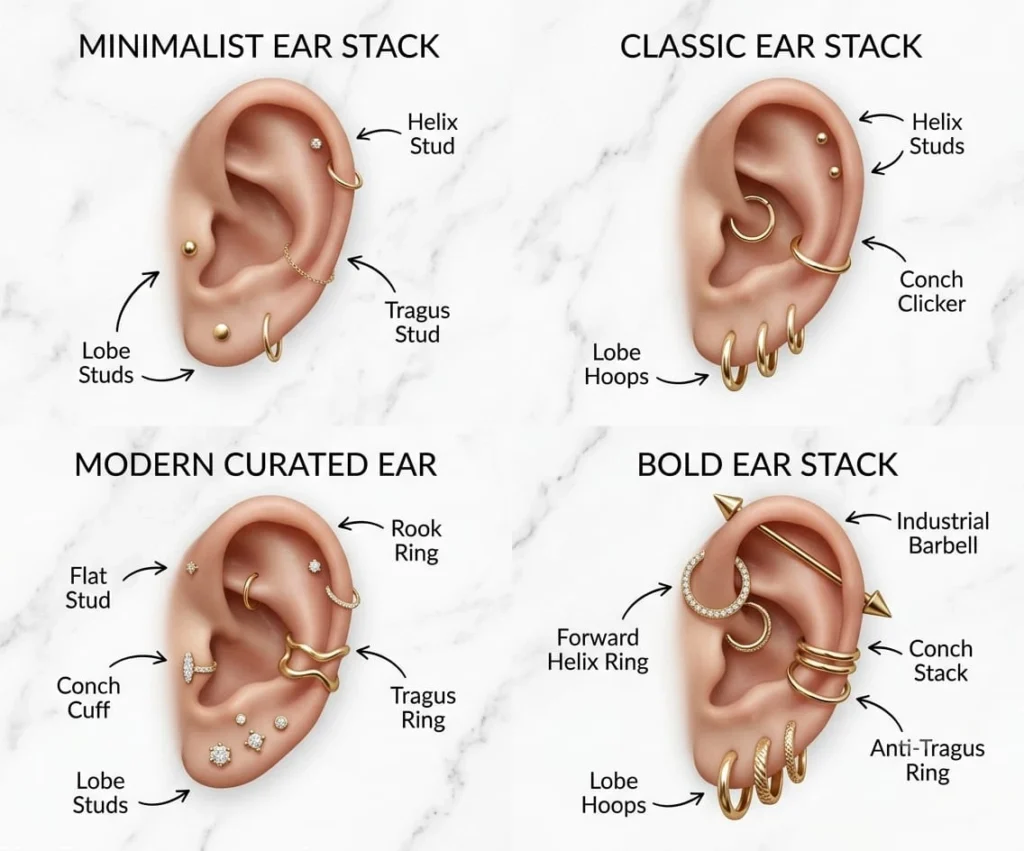
Minimalist Ear Stack
Perfect if you prefer a clean, elegant style: First Lobe, Second Lobe, Helix.
Classic Ear Stack
A balanced combination that suits most people: Double Lobe, Helix, Tragus.
Modern Curated Ear
A stylish option with multiple focal points: Double Lobe, Conch, Helix, Flat, Forward Helix.
Bold Ear Stack
Ideal for those who love statement jewelry: Industrial, Conch, Rook, Tragus, Double Lobe.
Ear Piercing Myths vs Facts
Many myths about ear piercings continue to circulate online. Here’s what’s actually true.
| Myth | Fact |
| Piercing guns are safer. | Professional needles create a cleaner opening and are recommended for cartilage piercings. |
| Twisting jewelry helps healing. | Twisting can damage new tissue and delay healing. |
| Cartilage always takes exactly six months to heal. | Healing varies by person and can take up to a year. |
| Alcohol cleans piercings best. | Sterile saline is usually the preferred cleaning solution. |
| Every ear can support every piercing. | Your anatomy determines which piercings are safe and suitable. |
| Daith piercings cure migraines. | Scientific evidence has not confirmed this claim. |
Common Mistakes to Avoid
Avoiding these common mistakes can go a long way toward helping your piercing heal faster and with fewer complications:
- Touching the jewelry with dirty hands
- Sleeping on a fresh piercing
- Changing jewelry too early
- Using alcohol or hydrogen peroxide
- Wearing low-quality jewelry
- Skipping your daily cleaning routine
- Removing jewelry during healing
- Swimming before the piercing has healed
Small habits like these can make a surprisingly big difference during recovery.
Frequently Asked Questions
What is the most popular ear piercing?
The lobe piercing remains the most popular choice overall because it heals quickly and suits almost everyone.
Which ear piercing hurts the most?
Most people consider the industrial piercing the most painful, since it combines two cartilage piercings connected by one bar.
Which ear piercing heals the fastest?
Lobe piercings usually heal within six to eight weeks, making them the fastest-healing ear piercing by a clear margin.
Which ear piercing is best for beginners?
A standard lobe piercing is the best starting point for beginners, thanks to its low pain level and short healing time.
Can I get multiple ear piercings at once?
Yes. Many professional piercers perform two or three piercings during a single appointment, though healing becomes more demanding as the number of piercings increases.
Can I sleep on a new ear piercing?
It’s best to avoid sleeping directly on a new piercing. A travel pillow or piercing pillow can help reduce pressure while you sleep.
Can I wear headphones after getting a piercing?
Over-ear headphones are usually more comfortable than earbuds for new tragus, conch, or daith piercings. It’s best to avoid anything that presses directly against the healing area.
When can I change my jewelry?
Wait until your piercer confirms that your piercing has fully healed. Changing jewelry too early can cause irritation and delay the healing process.
What jewelry is best for sensitive skin?
Implant-grade titanium is widely considered one of the best choices, since it’s lightweight, durable, and genuinely hypoallergenic.
Can I swim after getting my ears pierced?
It’s best to wait until your piercing has healed before swimming in pools, lakes, hot tubs, or the ocean, as these environments may expose the piercing to bacteria.
Can my ear reject a piercing?
Yes. Although uncommon, some piercings — especially surface piercings and industrial piercings — can migrate or be rejected by the body over time.
How do I know if my piercing is infected?
Persistent swelling, severe pain, spreading redness, fever, thick yellow or green discharge, or a foul smell are all signs that you should seek medical advice.
Expert Tips Before Getting an Ear Piercing
Keep these tips in mind for a smoother overall experience:
- Choose a licensed and experienced piercer.
- Ask whether implant-grade titanium jewelry is available.
- Eat a light meal before your appointment.
- Stay hydrated.
- Wear comfortable clothing that won’t catch on your jewelry.
- Follow your aftercare instructions carefully.
- Be patient — healing takes time.
Remember, a beautiful piercing starts with proper placement and consistent aftercare from day one.
Final Thoughts
The right ear piercing isn’t simply the one that looks best in a photo—it’s the one that matches your anatomy, fits your lifestyle, and is realistic for the healing process you’re willing to commit to. Taking a little extra time to compare placements, pain levels, healing times, and jewelry options now can help you avoid unnecessary complications later.
One pattern that consistently appears across professional piercing advice is that successful piercings depend less on pain during the appointment and far more on proper placement, quality jewelry, and consistent aftercare. Even more advanced cartilage piercings can heal well when they’re performed by an experienced piercer and cared for correctly.
If you’re still unsure which piercing to choose, use the ear piercing chart as a starting point rather than a final decision. Then visit a reputable professional piercer who can assess your ear anatomy, discuss your goals, and recommend the safest placement for you.
A well-planned piercing should look great not only on the day you get it but also months and years later. Choosing carefully, wearing high-quality jewelry, and being patient during healing will give you the best chance of enjoying your new piercing for years to come.