High Porosity Hair: Signs, Causes, and How to Care for It
Have you ever finished washing your hair, applied your favorite conditioner, and still felt like your hair was dry just a few hours later? If your hair becomes frizzy, tangles easily, or seems to absorb every product without staying soft, you are not alone. These are some of the most common frustrations people with high porosity hair face.
Many people assume they simply need more products or more expensive treatments. In reality, the problem is often not the amount of moisture your hair receives—it’s how quickly that moisture escapes. Understanding your hair’s porosity can completely change the way you care for it and help you stop wasting money on products that aren’t designed for your hair’s needs.
After reviewing current hair care guidance, comparing expert recommendations, and analyzing how high porosity hair behaves, one pattern becomes clear: a consistent routine built around moisture retention and strengthening the hair works far better than constantly switching products. Once you understand how high porosity hair behaves, choosing the right routine becomes much simpler.
In this guide, you’ll learn what high porosity hair is, what causes it, how to recognize the signs, and the best ways to care for it. You’ll also discover common mistakes to avoid, the ingredients that benefit high porosity hair most, and practical tips that can help your hair become softer, healthier, and easier to manage over time.
What Is High Porosity Hair?
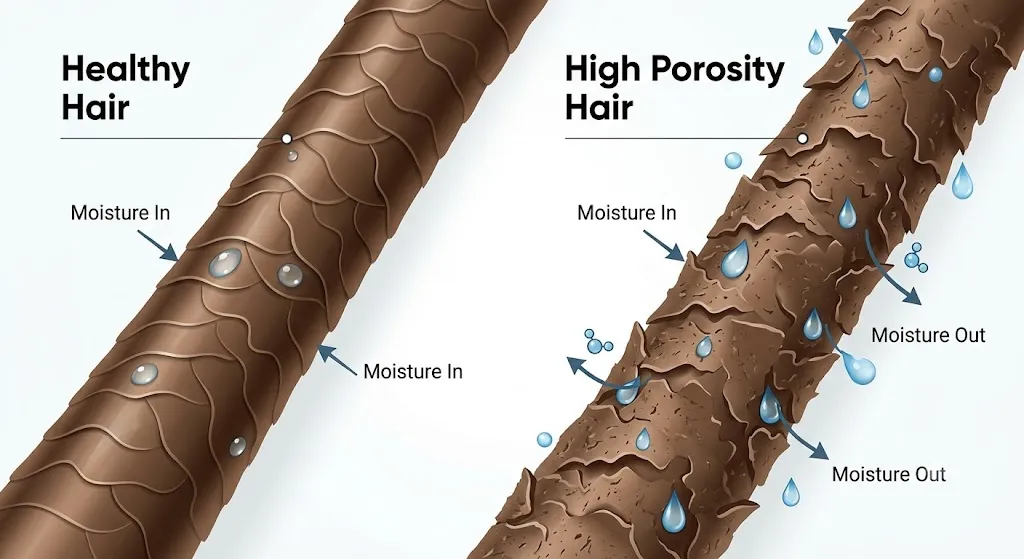
High porosity hair is hair whose cuticle layer sits more open than it should. The hair cuticle is the outer protective layer covering every single hair strand, made up of overlapping scales that control how water, oils, and hair products move both into and out of the hair.
Healthy hair typically has cuticles that lie relatively flat against the strand. These flat, closed cuticles help trap moisture inside the hair shaft while also shielding it from heat, friction, and everyday environmental damage.
With high porosity hair, however, the cuticles are raised or damaged, which creates tiny openings across the surface of each strand. Water, conditioners, and styling products can enter the hair very quickly through these openings, but they escape through the same gaps just as fast. That’s exactly why high porosity hair so often feels dry again shortly after washing or conditioning.
A helpful way to picture this is a sponge with unusually large holes. It soaks up water almost instantly, but it simply can’t hold onto that water for very long.
High porosity hair also tends to share a few common tendencies. It’s more likely to:
- Lose moisture quickly
- Become frizzy in humid weather
- Tangle easily
- Break more often
- Develop split ends
- Feel rough instead of smooth
It’s worth noting that hair porosity is a completely different concept from hair texture or curl pattern. Straight, wavy, curly, and coily hair can all have high porosity, and your hair can become more porous over time as a result of heat styling, bleaching, coloring, or repeated chemical treatments.
Understanding your hair’s porosity is really the first step toward building a routine that keeps it healthy, soft, and far easier to manage day to day. This also helps explain why high porosity hair so often feels dry even right after washing or conditioning – the hair absorbs moisture quickly, but simply can’t hold onto it for very long, which is why many people notice their hair turning rough, frizzy, or dehydrated just a few hours into the day.
Understanding Hair Structure
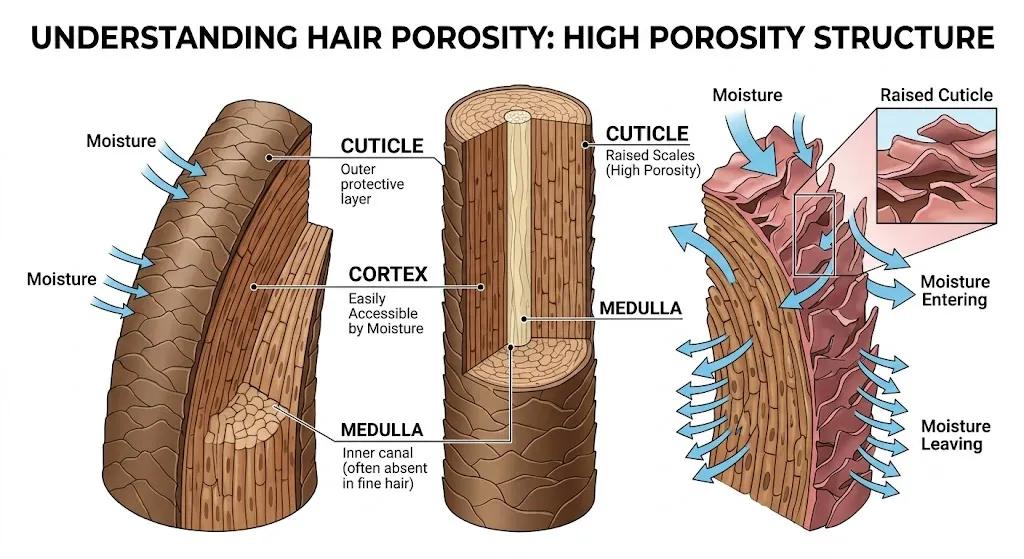
To really understand high porosity hair, it helps to know how a single strand is actually built. Every hair strand has three main layers, and each one plays a distinct role in protecting the hair, keeping it strong, and helping it hold onto moisture.
When high porosity develops, it primarily affects the outermost layer of the hair. This is what makes it easier for moisture to enter the hair shaft in the first place, but it’s also what allows that same moisture to escape so quickly afterward.
Cuticle
The cuticle is the outermost layer of the hair, made up of overlapping cells that function much like protective scales. A healthy cuticle lies flat against the strand, creating a smooth surface that locks moisture in while protecting the inner layers of the hair from damage.
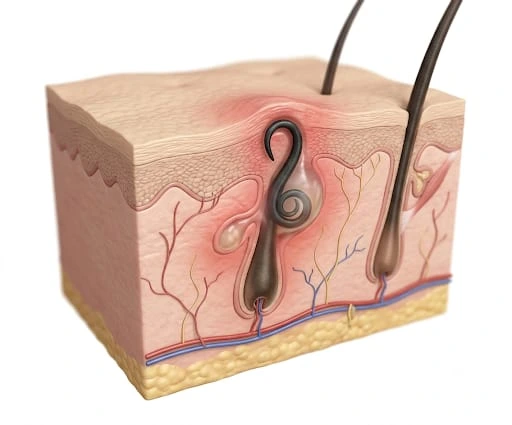
In high porosity hair, this cuticle becomes raised or damaged, and small gaps start to appear between the individual cuticle cells. These gaps allow water, oils, and hair products to move in and out of the hair far more easily than they should, which is a major reason high porosity hair so often ends up dry, frizzy, and difficult to manage.
Cortex
The cortex is the thick middle layer of the hair, and it contains the keratin proteins responsible for the hair’s overall strength and flexibility. It’s also where most of the hair’s natural moisture and pigment are stored.
When the cuticle above it becomes damaged, the cortex is left more exposed to heat, chemical treatments, and general environmental stress. Over time, this added exposure can lead to increased dryness, breakage, and split ends.
Medulla
The medulla is the innermost layer of the hair strand. It’s usually present in thicker hair but may be absent altogether in very fine hair. While it plays a smaller role in day-to-day hair care compared to the cuticle and cortex, it’s still a recognized part of the overall hair structure.
Understanding how these three layers work together makes it much easier to see why high porosity hair specifically needs products that add moisture, strengthen the strand, and protect the cuticle from further damage.
High Porosity Hair: Profile
High porosity hair is generally considered one of the more fragile hair types, simply because the cuticle struggles to hold onto moisture and nutrients for long. Even right after using a deep conditioner, the hair can feel dry again within a fairly short window of time.
People with high porosity hair often notice their hair changing noticeably throughout the day. It might look soft and hydrated right after washing, only to turn frizzy or rough just a few hours later, as moisture continues to escape through the open cuticle.
Some of the most common features associated with high porosity hair include the following:
- Absorbs water very quickly
- Dries faster than most hair types
- Feels dry even after conditioning
- Becomes frizzy in humid weather
- Tangles easily
- Breaks more often than healthy hair
- Has rough or uneven strands
- Develops split ends easily
- Looks dull instead of shiny
- Responds quickly to hair color and chemical treatments
High porosity hair isn’t always the result of damage, either. Some people naturally have more porous hair simply because of their genetics or hair type, while for others, repeated bleaching, coloring, heat styling, and harsh hair products gradually increase porosity over time.
It’s also worth remembering that high porosity hair isn’t “bad” hair – it simply behaves differently from other types. Once you understand what it actually needs, you can build a routine that helps lock in moisture, strengthen the strand, and reduce the everyday damage it’s more prone to. Many people see real improvement simply by introducing moisturizing products, using protein treatments only when needed, and adopting gentler styling methods that protect the cuticle.
What Makes Hair Increase Its Porosity Level?
Hair porosity isn’t fixed forever – it can change over time as your hair is exposed to different forms of damage. Every strand has a protective outer layer, the cuticle, and when this layer weakens or develops tiny gaps, the hair becomes more porous. That, in turn, makes it easier for moisture to enter the hair, but also easier for it to escape just as quickly.
For many people, high porosity develops gradually as a result of everyday habits and environmental exposure. The more the cuticle is worn down, the harder it becomes for the hair to stay healthy, smooth, and properly hydrated.
Here are the most common causes behind high porosity hair.
Heat Styling
Frequent use of flat irons, curling wands, and blow dryers can steadily weaken the hair cuticle. High heat pulls moisture out of the hair and causes the cuticle to lift over time, and without proper heat protection, repeated styling sessions can leave hair dry, brittle, and much more prone to breaking.
Bleaching and Hair Coloring
Chemical treatments are among the biggest contributors to increased hair porosity. Bleach works by physically opening the cuticle so it can strip away your natural hair pigment, and this process can leave behind permanent gaps in the cuticle that make it difficult for hair to hold onto moisture going forward. Even regular hair coloring can raise porosity when it’s done frequently or without proper aftercare.
Chemical Treatments
Hair relaxing, perming, rebonding, and similar chemical services all work by changing the hair’s natural structure. While these treatments can absolutely deliver the look you’re going for, they also weaken the protective cuticle in the process, and over time the hair may start to feel rough, dry, and noticeably more porous.
Excessive Sun Exposure
The sun does more than just fade your hair color. Extended UV exposure can damage the hair’s outer layer and wear down its natural protective barrier, which often leads to dryness, dullness, and increased porosity – especially during the summer months.
Chlorine and Salt Water
Swimming pools and seawater can both be surprisingly harsh on hair. Chlorine strips away the natural oils that help protect the cuticle, while salt water actively draws moisture out of the strand. Without proper aftercare following a swim, both can make existing high porosity noticeably worse.
Harsh Hair Products
Some shampoos and styling products rely on strong cleansing agents or drying alcohols that strip away too much of the hair’s natural oil. Over time, this can weaken the cuticle and make it harder for the hair to hold onto moisture, which is why choosing products suited to your specific hair type can make such a noticeable difference.
Mechanical Damage
Everyday habits can quietly increase hair porosity too. Rough towel drying, brushing wet hair carelessly, wearing tight hairstyles, or using accessories that pull on the hair can all slowly damage the cuticle. Each individual action might seem minor on its own, but the repeated stress adds up significantly over time.
Environmental Factors
Wind, pollution, dry air, and shifting weather conditions can all take a toll on your hair’s condition. These environmental stressors gradually wear down the cuticle and leave the hair more vulnerable to ongoing moisture loss.
Genetics
Not all high porosity hair is the result of damage. Some people simply have hair with a naturally more open cuticle structure, a trait that’s often seen in certain curly and coily hair types. If your hair has always absorbed water quickly and dried fast, your porosity may simply be a natural part of your hair’s characteristics rather than a sign of damage.
No matter what originally caused your high porosity hair, the right care routine can still help improve its appearance, reduce breakage, and make it noticeably easier to manage.
Can Hair Porosity Change Over Time?
Yes, hair porosity can absolutely change over time. While some people naturally have high porosity hair from the start, others develop it gradually as a result of repeated damage to the cuticle.
Heat styling, bleaching, hair coloring, chemical treatments, UV exposure, and everyday wear all work together to slowly weaken the hair’s protective layer. As the cuticle becomes more damaged, the hair starts absorbing moisture more quickly, but it also loses that moisture much faster than before.
It’s also fairly common for different sections of your hair to have different porosity levels at the same time. New hair growing in near the scalp tends to be healthier, while older hair further down the strand is often more porous simply because it’s been exposed to damage for a longer stretch of time.
Although damaged hair can’t permanently repair itself, using the right products alongside a gentle hair care routine can still improve its appearance, reduce breakage, and help it hold onto moisture more effectively going forward.
6 Characteristics of High Porosity Hair
Not sure whether your hair falls into the high porosity category? Its daily behavior can actually tell you quite a lot. While a simple water test gets mentioned often online, the easiest way to identify high porosity hair is usually by paying close attention to how it reacts during washing, styling, and different weather conditions.
Here are the most common signs to look out for.
1. Your Hair Gets Wet Very Quickly
One of the earliest signs of high porosity hair is simply how fast it absorbs water. The moment you step into the shower or spray your hair with water, it becomes fully saturated within seconds. This happens because the raised cuticle allows water to enter the hair shaft almost instantly.
2. Your Hair Dries Very Fast
Although your hair takes in water quickly, it loses it just as fast afterward. If your hair air-dries noticeably faster than expected, that’s often a sign that moisture is escaping through the open cuticle rather than staying locked inside the strand.
3. Your Hair Feels Dry Soon After Washing
Freshly washed hair should generally stay soft and hydrated for several hours. High porosity hair, on the other hand, often feels dry again shortly after washing simply because it struggles to retain moisture, which is why you may find yourself reaching for leave-in conditioners or hair oils more often than usual.
4. Frizz Is a Daily Problem
Frizz is one of the most common concerns for people dealing with high porosity hair. Because the cuticle sits raised, moisture from the surrounding air can move in and out of the strand very easily. This constant shift in moisture is what makes hair look puffy, rough, and hard to control, particularly in humid weather.
5. Your Hair Tangles and Breaks Easily
Raised cuticles create a rough, uneven surface that causes hair strands to catch on one another more easily. This leads to frequent tangles, knots, and breakage during brushing or styling, and split ends tend to become more common as a result.
6. Hair Color Absorbs Quickly but Fades Faster
High porosity hair usually takes in hair color very easily, since the cuticle is already sitting open. While this can make the coloring process itself faster, that same color also tends to wash out more quickly, because the cuticle simply can’t hold onto pigment as effectively as a healthier one would.
If several of these signs sound familiar, there’s a good chance your hair has high porosity. The upside is that understanding these characteristics makes it much easier to choose the right products and build a routine that keeps your hair hydrated, stronger, and healthier over the long run.
How to Care for High Porosity Hair
High porosity hair really needs a routine built around two priorities: adding moisture and keeping that moisture locked inside the strand. Because the cuticle sits more open than normal, water and nutrients tend to escape quickly, which is exactly why your hair may still feel dry even right after using a conditioner or hair mask.
Here are the most effective ways to care for high porosity hair.
A Simple Daily Routine for High Porosity Hair
If you’re not sure where to start, it helps to keep things simple. Wash your hair with a gentle shampoo when it’s actually needed, follow up with a moisturizing conditioner, apply a leave-in conditioner to damp hair, and finish with a lightweight oil or serum to help seal in that moisture. From there, deep condition once a week and reach for protein treatments only when your hair starts showing signs of weakness or breakage.
Use a Gentle Shampoo
Healthy hair care really does start with a good shampoo. Choosing a gentle, moisturizing formula lets you clean the scalp without stripping away the natural oils your hair depends on.
Harsh cleansers can leave high porosity hair even drier than before, so it’s worth looking for formulas made specifically for dry or damaged hair, especially ones built around moisturizing ingredients.
If your hair feels dry after every single wash, it may simply mean you’re washing it too often. Try washing only when your scalp actually needs cleansing rather than sticking to a fixed schedule out of habit.
Never Skip Conditioner
Conditioner is one of the most important products in any high porosity hair routine. It smooths the cuticle, improves overall softness, and helps cut down on moisture loss throughout the day.
Apply conditioner from the middle of your hair down to the ends, and leave it on for a few minutes before rinsing so the ingredients have enough time to actually work. For hair that’s especially dry, a richer conditioner formulated for damaged or moisture-starved hair tends to work best.
Deep Condition Every Week
A weekly deep conditioning treatment can make a genuinely noticeable difference. Deep conditioners deliver more moisture than a standard conditioner and can meaningfully improve the look and feel of dry, rough hair.
Leave the treatment on according to the product’s instructions, since consistent use tends to reduce frizz, improve softness, and make hair much easier to detangle over time.
Balance Moisture and Protein
High porosity hair usually benefits from a combination of both moisture and protein. Moisture keeps the hair soft and flexible, while protein helps reinforce the weaker areas within the hair shaft itself.
Too much moisture without enough protein can leave hair feeling limp and overly stretchy, while too much protein can make it feel stiff or brittle instead. The real key is finding the right balance between the two.
If your hair stretches too much before it breaks, it may be a sign that it needs more protein. If it feels rough, hard, or brittle instead, it’s likely asking for more moisture. Paying attention to how your hair responds to different products over time will help you find that balance more naturally.
Seal Moisture with Hair Oils
Hair oils help seal moisture inside the hair rather than adding moisture themselves. Apply a few drops after your leave-in conditioner, focusing on the mid-lengths and ends to help reduce moisture loss.
Reduce Heat Styling
Frequent heat styling tends to make high porosity hair worse over time, since excessive heat both weakens the cuticle and speeds up moisture loss.
Whenever you can, let your hair air dry instead. When you do use a blow dryer, flat iron, or curling iron, always apply a heat protectant beforehand and stick to the lowest effective temperature. Giving your hair regular breaks from heat styling altogether can help prevent future damage from building up.
Protect Your Hair While Sleeping
Cotton pillowcases create friction that can increase both frizz and breakage overnight, so switching to a satin or silk pillowcase can meaningfully reduce that rubbing while you sleep.
If you have long hair, loosely braiding it or tying it into a soft pineapple style before bed helps prevent tangles and keeps unnecessary stress off the strands overnight.
Trim Split Ends Regularly
Split ends can’t be repaired once they form – the damage will simply keep traveling up the hair shaft unless it’s trimmed away.
Regular trims help keep your hair looking healthier overall and reduce further breakage down the line.
Be Gentle with Your Hair
Small daily habits genuinely add up over time. Try to avoid rubbing your hair roughly with a towel after washing, and instead gently squeeze out excess water using a microfiber towel or a soft cotton T-shirt.
A wide-tooth comb works well for detangling damp hair, starting from the ends and working your way upward. This approach reduces pulling and helps prevent unnecessary breakage.
Protein vs. Moisture: Finding the Right Balance
One of the biggest challenges with high porosity hair is striking the right balance between protein and moisture. Both play an important role, but leaning too heavily on either one can leave your hair looking and feeling unhealthy.
Moisture is what keeps hair soft, smooth, and flexible, while protein helps strengthen the weaker areas of the hair shaft and improves its resistance to breakage. The best routines usually include both, adjusted depending on what your hair actually needs at any given time.
If it feels like every new product works well for a few days and then suddenly stops delivering results, the issue may not be the product itself. High porosity hair often needs a specific combination of moisture, protein, and sealing ingredients, and using products that don’t match what your hair currently needs can leave it feeling either dry or overloaded.
Signs Your Hair Needs More Protein
Your hair may be asking for a protein treatment if you notice:
- Hair stretches too much before breaking
- Hair feels weak or limp
- Curls lose their definition
- Hair breaks easily when wet
Signs Your Hair Needs More Moisture
Your hair may need more moisture if you notice:
- Hair feels rough or brittle
- Hair looks dull and lifeless
- Frizz is difficult to control
- Hair feels stiff after washing
Paying attention to how your hair responds after each wash day is usually far more useful than overhauling your entire routine all at once – small, deliberate adjustments tend to work better than dramatic changes.
Best Products for a High Porosity Hair Routine
Using the right products matters just as much as following the right routine. High porosity hair loses moisture quickly, so every product in your lineup should be working to hydrate, strengthen, or protect the hair in some way.
Rather than buying up every product on the shelf, it’s more effective to focus on formulas that genuinely meet your hair’s specific needs.
Strengthening Products
If your hair has been damaged by bleach, coloring, or heat styling, strengthening treatments can go a long way toward improving its condition. Look for products built around ingredients such as:
- Hydrolyzed keratin
- Hydrolyzed wheat protein
- Silk protein
- Rice protein
- Amino acids
These ingredients temporarily reinforce the weaker areas of the hair shaft and help cut down on breakage.
Moisturizing Treatments
Moisturizing products help replace the water that high porosity hair loses throughout the day. Look for masks and conditioners containing ingredients like:
- Shea butter
- Aloe vera
- Glycerin
- Panthenol
- Coconut-derived moisturizers
Using a moisturizing hair mask once or twice a week can noticeably improve softness and reduce dryness over time.
Leave-In Conditioners
A leave-in conditioner provides ongoing hydration well after you’ve finished washing your hair. It also makes detangling considerably easier and helps keep frizz under control. Applying it to damp hair before styling tends to give the best results.
Hair Oils and Serums
Oils and serums help seal the cuticle and cut down on moisture loss throughout the day. Some popular choices include:
- Argan oil
- Jojoba oil
- Grapeseed oil
- Avocado oil
Just a few drops are usually enough – using too much can leave the hair feeling greasy rather than nourished.
Styling Products
Choose styling products that add moisture without leaving behind heavy buildup. Curl creams, lightweight styling creams, and moisturizing gels can all help define curls, reduce frizz, and protect the hair throughout the day.
Do You Need Every Product?
No, a healthy routine doesn’t have to be expensive or complicated. Many people see great results with just a gentle shampoo, a moisturizing conditioner, a leave-in conditioner, and a lightweight oil. Once your hair becomes noticeably healthier, you can start adding in extra treatments only as needed.
Seasonal Hair Care Tips for High Porosity Hair
The condition of high porosity hair can shift quite a bit with the seasons, so adjusting your routine throughout the year can help your hair stay healthier and better hydrated overall.
Summer
Sunlight, chlorine, and salt water can all make high porosity hair even drier during the warmer months. Wearing a hat during long periods outdoors, rinsing your hair after swimming, and using a leave-in conditioner regularly can all help reduce moisture loss.
Winter
Cold temperatures combined with indoor heating tend to dry hair out significantly. Deep conditioning regularly and switching to richer moisturizing products can help maintain hydration through the colder months.
Humid Weather
Humidity tends to increase frizz because high porosity hair absorbs moisture from the surrounding air so easily. Applying a lightweight serum or anti-frizz product can help smooth the cuticle and improve overall manageability in these conditions.
Dry Climates
Dry air causes moisture to leave the hair more quickly than usual. Using a leave-in conditioner followed by a lightweight oil can help seal moisture inside the strand throughout the day.
High Porosity Hair vs. Low vs. Medium Porosity Hair
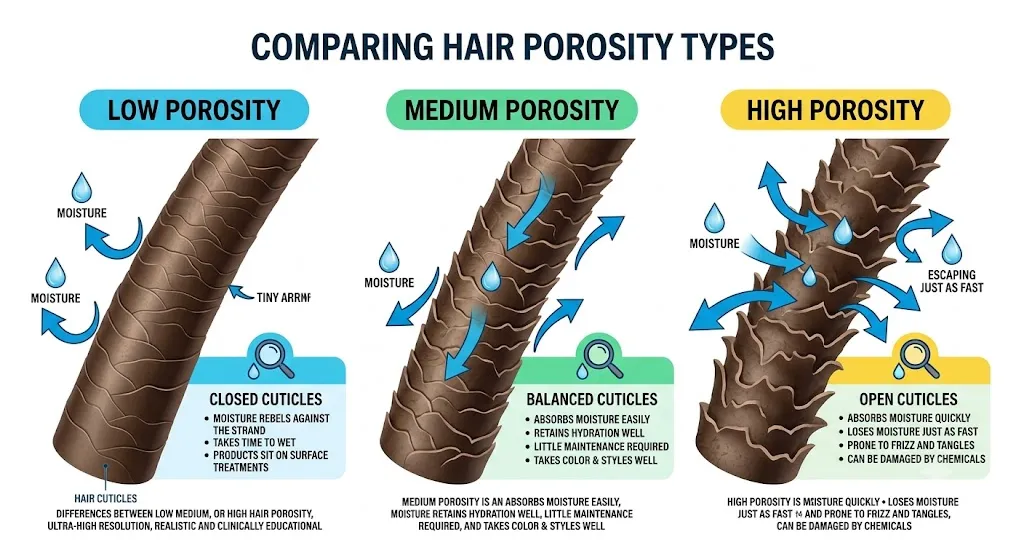
Not all hair absorbs and holds onto moisture in the same way. Hair porosity is generally divided into three categories – low, medium, and high – and the difference really comes down to how open or closed the hair cuticle is.
Understanding where your hair falls can help you choose products that actually match its needs, rather than following a routine that happens to work well for someone else.
The table below breaks down the key differences between the three porosity types.
| Feature | Low Porosity Hair | Medium Porosity Hair | High Porosity Hair |
| Cuticle | Tightly closed | Slightly open | Widely open |
| Water Absorption | Slow | Moderate | Very fast |
| Moisture Retention | Excellent | Good | Poor |
| Drying Time | Slow | Average | Fast |
| Product Absorption | Slow | Balanced | Very fast |
| Frizz | Less common | Moderate | Very common |
| Shine | Naturally shiny | Healthy shine | Often dull |
| Breakage | Low | Moderate | Higher risk |
| Hair Care Goal | Help moisture enter | Maintain balance | Lock moisture inside |
Low porosity hair often struggles to absorb moisture in the first place because the cuticle sits so tightly packed. Medium porosity hair tends to be the easiest to manage overall, since it absorbs and retains moisture in a fairly balanced way. High porosity hair, by contrast, absorbs products quickly but loses hydration just as fast, which makes moisture retention the single biggest challenge for this hair type.
Knowing your hair’s porosity level makes it far easier to build a routine that actually delivers lasting results.
What Are Other Things That High Porosity Hair Likes?
A good routine matters, but healthy hair also depends heavily on the ingredients you’re actually using. High porosity hair tends to respond best to ingredients that strengthen the strand, improve moisture retention, and protect the cuticle from further damage.
Here are some of the most beneficial ingredients worth looking for.
Keratin and Hydrolyzed Proteins
Hair is made mostly of keratin, and when the cuticle becomes damaged, small gaps can develop within the hair shaft itself. Hydrolyzed proteins work by temporarily filling in these weak areas, which leaves the hair feeling noticeably stronger and smoother. Common protein ingredients to look for include hydrolyzed keratin, hydrolyzed wheat protein, hydrolyzed silk protein, rice protein, and soy protein. If your hair feels weak or breaks easily, products containing these ingredients may help improve its overall condition.
Humectants
Humectants work by attracting water and helping keep the hair hydrated for longer. Popular options include glycerin, aloe vera, panthenol (vitamin B5), honey, and sodium PCA. These ingredients tend to work best when followed by a conditioner, cream, or oil that helps seal that moisture inside the hair afterward.
Emollients
Emollients help smooth the hair cuticle and reduce roughness, while also making the hair feel noticeably softer and easier to manage. Some common emollients include shea butter, cocoa butter, mango butter, and fatty alcohols such as cetyl alcohol and stearyl alcohol. These ingredients help reduce frizz while improving overall softness.
Hair Oils
Lightweight plant oils create a protective layer around each hair strand, which helps reduce ongoing moisture loss. Some of the best oils for high porosity hair include argan oil, avocado oil, grapeseed oil, sweet almond oil, and jojoba oil. Heavier oils sit differently; the evidence on castor oil for hair is thinner than its popularity suggests. Using just a few drops after your leave-in conditioner helps lock hydration in effectively.
Ceramides
Ceramides are natural lipids that support the hair’s protective barrier, helping reduce moisture loss and improve the overall appearance of damaged hair. While they’re not found in every product, conditioners and masks containing ceramides can be a genuinely valuable addition to a high porosity hair routine.
Amino Acids
Amino acids are the fundamental building blocks of protein, and they help strengthen weak hair while improving flexibility without weighing the strand down. Many strengthening shampoos, conditioners, and treatments include amino acids specifically to support damaged hair.
When choosing products, it helps to focus on the actual ingredient list rather than marketing claims on the front of the bottle – reading the ingredients is usually the more reliable way to find products that truly benefit high porosity hair.
Things to Avoid If You Have High Porosity Hair
Just as certain products help high porosity hair thrive, others can make it drier, weaker, and considerably harder to manage. Avoiding these common mistakes can go a long way toward protecting your hair and supporting its long-term health.
Excessive Heat Styling
Using hot styling tools every single day can accelerate cuticle damage and speed up moisture loss significantly. Whenever possible, let your hair air dry, or at minimum use the lowest heat setting available along with a heat protectant.
Frequent Bleaching and Chemical Treatments
Bleaching, relaxing, rebonding, and frequent coloring all gradually weaken the hair cuticle over time. If you do color your hair, give it enough time to recover between treatments and use products specifically designed for chemically treated hair.
Harsh Shampoos
Strong cleansing shampoos can strip away the natural oils that help protect your hair. Choosing gentle, moisturizing formulas over harsh clarifying shampoos for everyday use tends to serve high porosity hair much better.
Overusing Protein Treatments
Protein does help strengthen high porosity hair, but more isn’t always better. Using protein treatments too often can leave hair feeling stiff, rough, or brittle, so it’s worth alternating them with moisturizing products to maintain a healthy balance.
Skipping Leave-In Conditioner
Because high porosity hair loses moisture so quickly, skipping a leave-in conditioner allows hydration to escape even faster than usual. Even a lightweight leave-in can make a genuinely noticeable difference in softness and frizz control.
Rough Towel Drying
Rubbing wet hair with a towel creates friction that can lift the cuticle even further. Instead, gently squeeze out excess water using a microfiber towel or a soft cotton T-shirt.
Tight Hairstyles
Very tight ponytails, buns, or braids place unnecessary stress on the hair shaft, which can lead to breakage over time. Choosing looser hairstyles whenever possible, especially while sleeping, helps take some of that pressure off.
Ignoring Split Ends
Split ends can’t repair themselves, and delaying a trim simply allows the split to travel further up the hair shaft, causing additional damage along the way. Regular trims help keep the hair looking healthier and reduce breakage over time.
Using Too Many Products
Applying several heavy creams, oils, and styling products all at once can lead to buildup, which often leaves the hair feeling dull and lifeless instead of hydrated. It’s better to use only the products your hair actually needs, and clarify occasionally if buildup starts to become noticeable.
By steering clear of these common mistakes and sticking to a consistent routine, high porosity hair can become noticeably softer, smoother, and much easier to manage over time.
Troubleshooting Common High Porosity Hair Problems
Even with a consistent routine in place, high porosity hair can still run into the occasional problem. Understanding the likely cause makes it much easier to choose the right solution.
| Problem | Possible Cause | What You Can Do |
| Hair feels dry after conditioning | Moisture escapes quickly through the cuticle | Apply a leave-in conditioner and seal it with a lightweight oil. |
| Hair becomes frizzy within hours | High humidity and raised cuticles | Use a moisturizing styling cream followed by a serum. |
| Hair breaks easily | Weak or damaged hair shaft | Add a protein treatment to your routine every few weeks. |
| Hair feels greasy or heavy | Product buildup | Wash with a clarifying shampoo occasionally and follow with a deep conditioner. |
| Hair tangles frequently | Rough cuticle surface | Detangle gently using conditioner and a wide-tooth comb. |
Common Myths About High Porosity Hair
There’s a fair amount of misinformation about hair porosity circulating online, and understanding the actual facts can help you make better decisions when choosing products and building your routine.
Myth: Oils Moisturize Hair
Fact: Hair oils help reduce moisture loss, but they don’t actually add moisture to dry hair on their own. For the best results, apply oil after using a leave-in conditioner or another water-based moisturizer first.
Myth: High Porosity Hair Is Always Damaged
Fact: High porosity hair isn’t always the result of damage. Some people simply have a naturally more open cuticle structure because of their genetics or hair type.
Myth: More Protein Always Means Healthier Hair
Fact: Protein does help strengthen the hair, but using too much of it can leave hair feeling stiff and brittle. A balance of protein and moisture usually produces the best overall results.
Myth: The Float Test Always Gives Accurate Results
Fact: Hair products, natural oils, and product buildup can all skew the results of a float test. Paying attention to how your hair actually behaves during washing, drying, and styling tends to be a far more reliable way to understand its true porosity.
Frequently Asked Questions
Can high porosity hair be repaired?
Not fully – hair is made of dead cells, so once the cuticle is damaged by heat, bleach, or chemicals, that portion can’t truly heal. The right routine can still improve how it looks and feels, though: deep conditioning, protein treatments, and gentle handling all help reduce breakage and boost softness. New growth from the scalp will be healthier if you protect it going forward.
Is high porosity hair genetic?
Yes, it can be. Some people naturally have a more open cuticle, especially with certain curly and coily hair types, while others develop high porosity later from bleaching, coloring, heat styling, or chemical treatments.
How often should I wash high porosity hair?
There’s no fixed schedule – wash when your scalp needs it, not on autopilot. A gentle, moisturizing shampoo followed by conditioner helps maintain hydration. Oily scalps may need more frequent washing; very dry hair often does better with less.
Does high porosity hair need protein? Yes, but in moderation. Protein strengthens weak spots in the hair shaft and reduces breakage, but overusing it can leave hair stiff or brittle. A balanced routine with both protein and moisture usually works best.
What are the best oils for high porosity hair?
Lightweight oils like argan, jojoba, grapeseed, avocado, and sweet almond oil work well. Apply a small amount after your leave-in conditioner to help seal in moisture.
Is coconut oil good for high porosity hair?
It depends on the hair. Some people find it reduces protein loss and protects the strand, while others find it drying or stiffening. It’s worth testing a small amount first.
Why is my high porosity hair always frizzy?
The raised cuticle lets moisture move in and out too easily, so humidity makes the hair swell and frizz. A leave-in conditioner, a sealing oil, and less heat styling can all help.
Can high porosity hair grow long?
Yes – it grows at a normal rate, but breakage makes it harder to retain length. Gentle care, regular trims, and consistent moisture help you keep more of the length you grow.
How can I tell if my hair is high porosity?
Watch how it behaves day to day: it gets wet within seconds, dries fast, feels dry soon after washing, frizzes and tangles easily, breaks more than usual, and absorbs color quickly. That’s more reliable than a single home test.
Key Takeaways
High porosity hair absorbs moisture quickly but loses it just as fast, simply because the cuticle sits more open than normal. Left unaddressed, this can lead to dryness, frizz, tangles, and breakage over time.
The best routine focuses on adding moisture, strengthening weak areas, and sealing that hydration inside the hair. Gentle shampoos, rich conditioners, deep conditioning treatments, leave-in conditioners, and lightweight oils all play an important role in keeping the hair healthy.
It’s also worth avoiding excessive heat, harsh chemicals, and rough handling, since these habits tend to make high porosity hair even more fragile over time. Remember that healthy hair isn’t really about using the most products – it’s about using the right products consistently and genuinely understanding what your hair needs.
With patience and the right ongoing routine, high porosity hair can become softer, shinier, stronger, and considerably easier to manage.
Final Thoughts
High porosity hair can be frustrating, especially when it feels like nothing keeps your hair moisturized for long. I’ve found that many people focus on buying more products when the real improvement comes from understanding how their hair behaves and building a routine that matches its needs. Small, consistent changes usually produce better results than constantly changing shampoos, conditioners, or styling products.
The most effective routines are also the simplest. Prioritizing gentle cleansing, regular conditioning, deep hydration, balanced protein treatments, and protecting the hair from unnecessary damage can make a noticeable difference over time. While damaged hair cannot be permanently repaired, healthy habits can improve its appearance, reduce breakage, and help you retain healthier hair as it grows.
Every person’s hair is different, so don’t expect overnight results or assume that someone else’s routine will work exactly the same for you. Pay attention to how your own hair responds, make gradual adjustments, and stay consistent. In my experience reviewing hair care recommendations and comparing what consistently works across trusted sources, people see the best long-term results when they build a routine around their hair’s actual needs instead of chasing quick fixes.
With patience and the right approach, high porosity hair can become softer, stronger, more manageable, and easier to care for. The goal isn’t perfect hair—it’s healthy hair that you understand and know how to maintain.